As a queer parent and as the spouse of a trans person with reproductive health challenges, I have experienced firsthand how the right to accessible and non-stigmatizing abortion care interconnects with access to other essential healthcare and bodily autonomy. This is why I am so excited to share Pro-Choice Washington’s new How To Talk About Abortion guide.
With the leaked U.S. Supreme Court opinion that overturns Roe v. Wade, if upheld, the threat to our fundamental right to bodily autonomy is in direct peril. We urgently need to shift the culture of how we talk about abortion to help protect and promote access across our state and within our communities of influence.
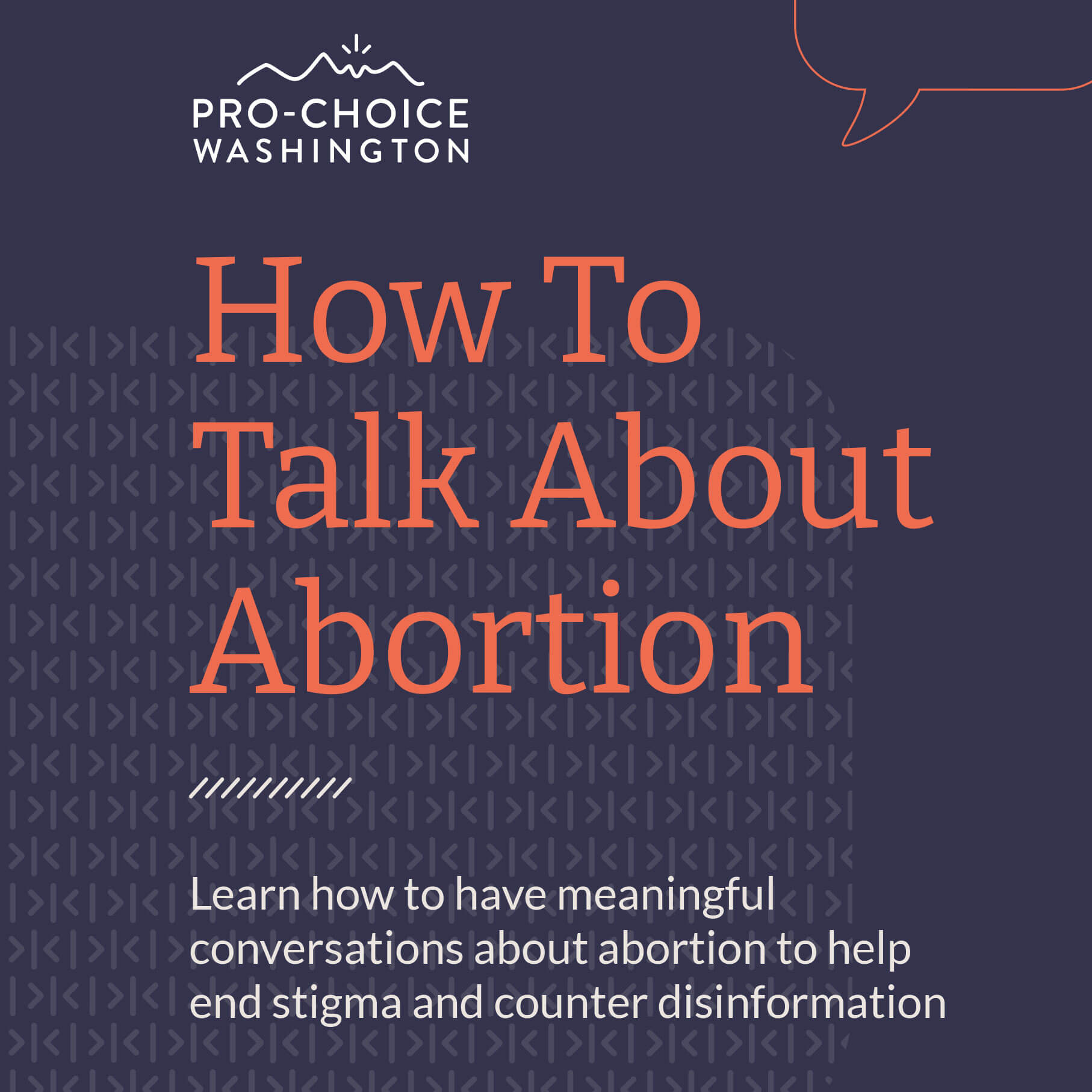
The How To Talk About Abortion guide is desperately needed at this pivotal moment because how we talk about abortion informs so many other conversations our country is having today —conversations about whose bodies matter, who deserves care, and who is trusted to make decisions for themselves and their families.
The guide recommends which language to use on key topics—such as how to define abortion care, how to speak inclusively, and how to understand equitable access to abortion—and provides examples of how you can apply this to your own conversations. This information will help support people in your life who need or who have had abortion care, and it will help to end abortion stigma.
The coordinated effort of anti-abortion opponents to promote fear, shame, and unnecessary barriers around abortion care has had an insidious, corrosive effect on access to quality, affordable reproductive healthcare for all of us. This is felt even more deeply in low-income, BIPOC, rural, and LGBTQIA+ communities.
For too long, the anti-abortion movement has controlled the terms of the debate, framing themselves as “pro-life” and the reproductive rights and justice movement as “anti-life”. In reality, our humanity and bodily autonomy are not up for debate. The freedom to choose when and how to become a parent is inherently life-affirming.
So, we must actively reject this harmful terminology by:
- Talking about abortion as an act of love and care;
- Using clear, accurate, and unapologetic terms to drive culture change around abortion care; and
- Speaking in inclusive, gender-neutral ways that recognize the real and disproportionate barriers that many patients face.
I began organizing around abortion rights in 1994 when I was just 12 years old. A family friend recruited me to volunteer with a peer-to-peer program to destigmatize and demystify conversations around abortion, HIV/AIDS, and sexual health for youth.
The mid-nineties were a challenging time for these conversations, with rising anti-abortion violence, homophobia, and racism driving the spread of fear, stigma, and misinformation. As a youth in that context, I found it incredibly empowering to be given the tools to facilitate clear, open, and factual conversations in my community to push back against those harmful narratives.
Now, as we feel the impact of increasingly extreme state and federal abortion restrictions, we must again equip ourselves to speak about abortion in clear, accurate, and non-stigmatizing terms.
Each of us has the power to protect and promote abortion access by boldly speaking with family, friends, and our communities to help shift the culture around abortion, using tools like the How To Talk About Abortion guide.
Sami Alloy (she/her) serves as Deputy Director of Pro-Choice Washington. A graduate of Portland State University and a veteran of numerous social justice campaigns, Sami believes that bodily autonomy and reproductive freedom, including abortion access, are fundamental human rights for residents of Washington State and for everyone.